

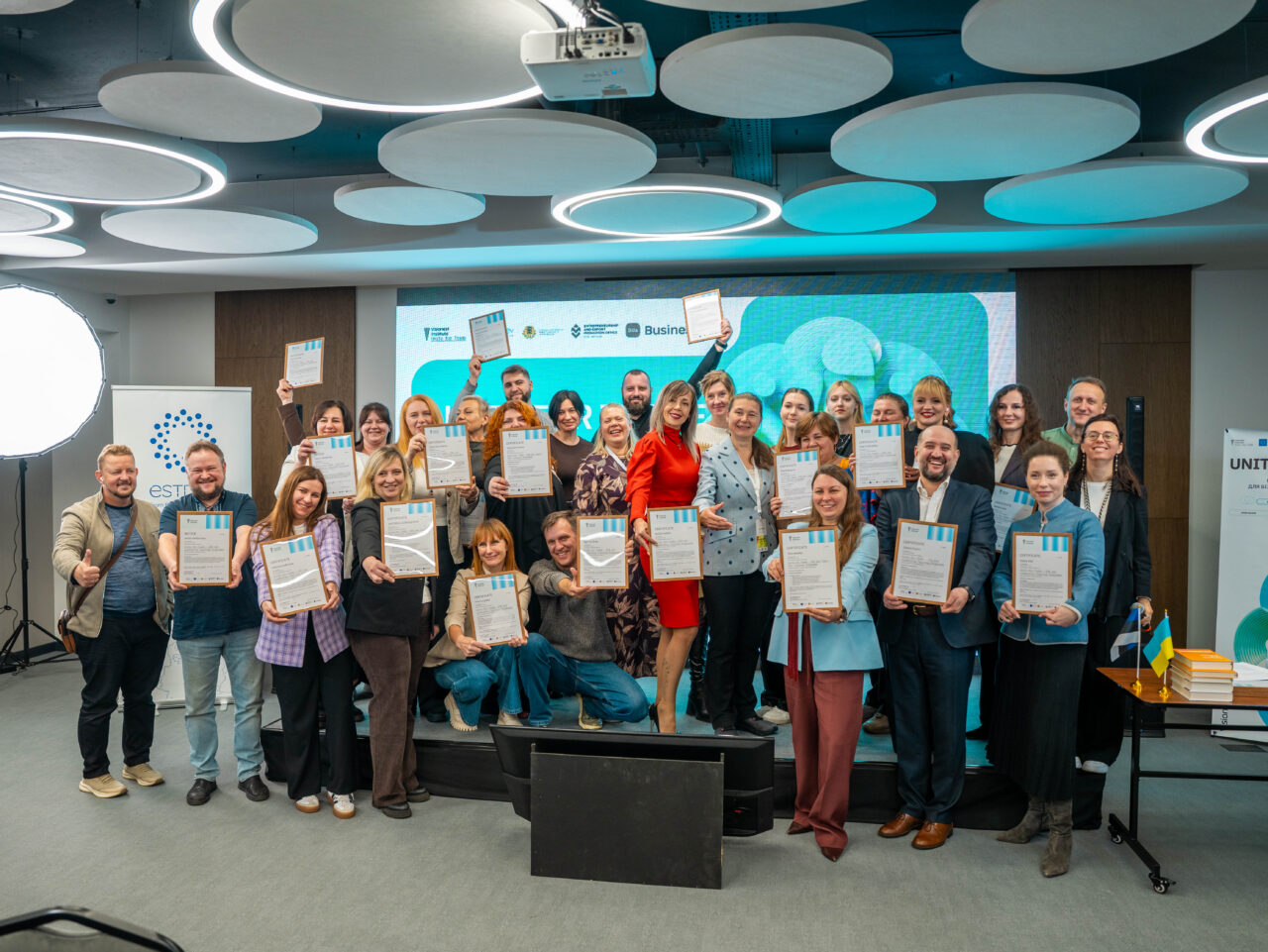
GALLERY ⟩ Unite for Trade: 13 months of learning and cooperation with Zhytomyr entrepreneurs
Businesses developed amidst the war, solutions born from lessons learned

Air alerts also accompanied the day when Zhytomyr entrepreneurs summarized 13 months of learning and cooperation. In the Visionest Institute's "Unite for Trade" program, which concluded on September 24, businesses were developed amidst the war, export opportunities were sought, and new partners were found.
Unite for Trade Final Forum 24.09.2026
Air raid alarms also marked the day when Zhytomyr entrepreneurs summed up 13 months of learning and cooperation. In the Visionest Institute’s Unite for Trade programme, which concluded on 24 September, businesses were developed, export opportunities were sought and new partners were found in the midst of war.
- Strong exports begin with effective cooperation in the home region.
Unite for Trade connected experienced exporters with smaller companies and service providers to strengthen local supply and cooperation relationships. The central idea of the programme: reaching the international market is supported by a company having reliable partners already at home. - From the desire for growth to concrete action plans.
In the mentorship programme, companies analysed production and supply bottlenecks, identified where profit margins were being lost, and looked for opportunities to create greater added value. As a result of the first stage, 12-month action plans were created for the companies. - A practical foundation for cooperation was created: 109 individual business meetings.
In the mentorship module, 14 service companies introduced their services, and 109 B2B meetings took place. These led to cooperation prospects, advice, and new contacts. - Entrepreneurs also opened up to each other about complex management problems.
In the business club's ‘hot seat’ format, for example, solutions were sought with the Lehka Khoda team for resistance to change, developing work culture, and onboarding new employees. According to the company’s feedback, they received ideas and solutions to test in their daily work. - Estonian and Ukrainian cooperation gained concrete business content.
Digital business forums brought Ukrainian producers and their cooperation offers to Estonian companies. - Read previous articles about Unite for Trade!
At the closing event, entrepreneurs talked about which learned skills had already changed their daily work — and what they plan to do next.
View the closing event gallery and follow the feedback on LinkedIn.
On September 24, the entrepreneurship program Unite for Trade concluded in Zhytomyr, Ukraine, which over the course of a year and one month brought together the region's entrepreneurs, Estonian and Ukrainian experts, and international mentors. The air raid sirens that sounded during the day were a reminder of the conditions in which Ukrainian companies operate every day.
Despite this, the meeting was filled with warm conversations, smiles, and joy over what had been accomplished together. At the same time, there was a sense of sadness associated with the conclusion: the regular training sessions, company visits, and discussions had developed into a collaborative network connecting the participants.
Unite for Trade, implemented by the Visionest Institute, supported companies in the Zhytomyr region in developing exports, business models, and responsible management. The program, supported by Estonia and the Estonian Centre for International Development (ESTDEV), combined learning with the practical issues of companies and new opportunities for cooperation.
Issues from their own companies were incorporated into the studies
The program included an export academy, business model development, and ESG (Environmental, Social, and Governance) principles training. These were complemented by regional business clubs, company visits, a study trip to Estonia, and Estonian-Ukrainian business forums.
With the support of mentors, they worked on opportunities related to value chains, practiced presenting their offers, and participated in business-to-business meetings.
Participant Yuliia Khudiakova, who completed all three tracks – training for export-oriented companies, mentoring, and ESG – said in her feedback that what helped integrate the learning into daily work was that homework was based on the examples of the companies where the participants work. Together, they discussed problematic issues and sought solutions. The business clubs and company visits, in turn, provided an opportunity to see how work and processes are organized in other organizations.
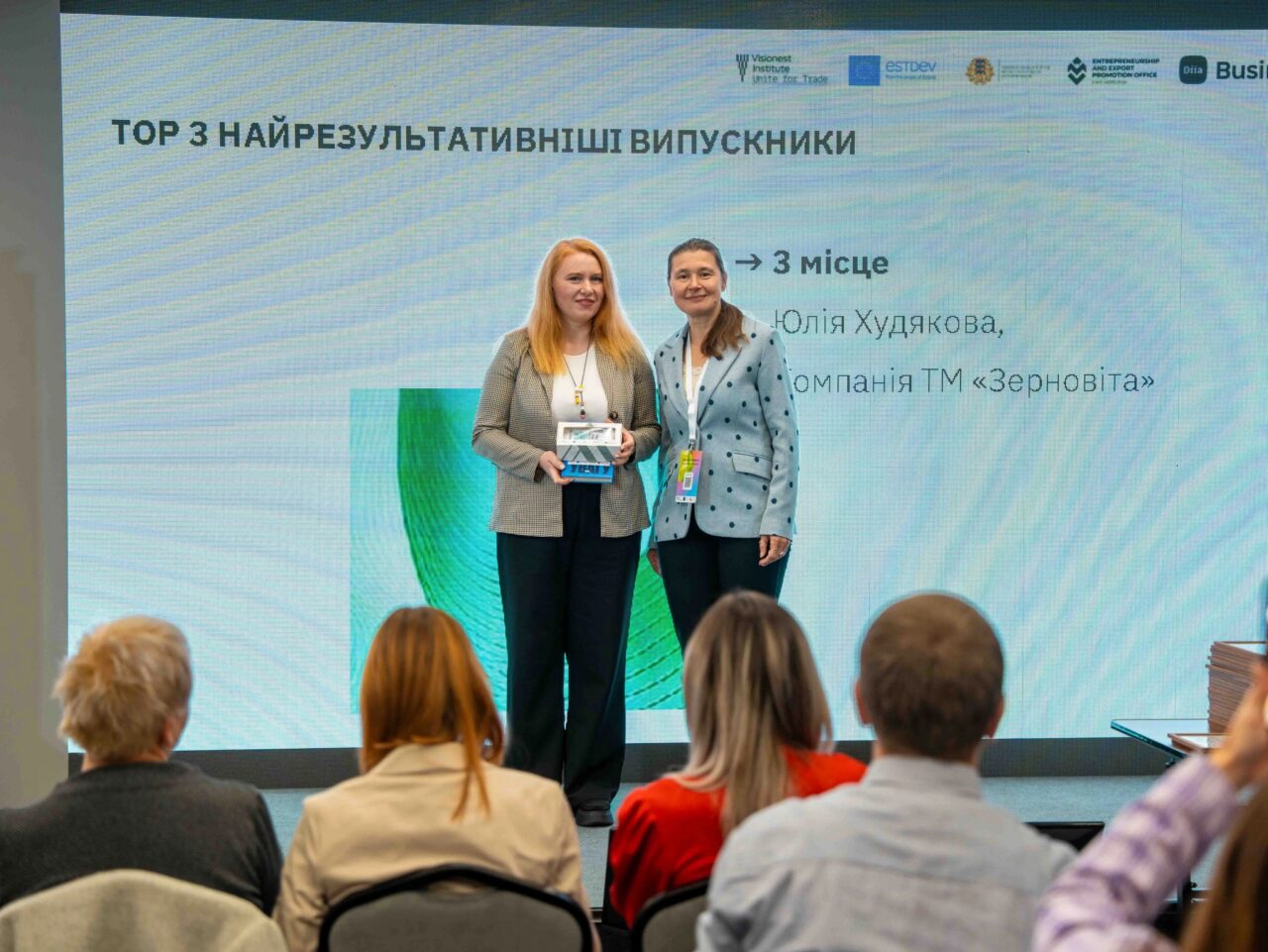
"This program was tremendously beneficial for me. I had set a goal for myself to study in 2025, and thanks to this program, I was able to achieve that goal. I have never chased grades, but consistent work earned me third place in the final results," Khudiakova described.
Her experience shows how long-term learning allows for the step-by-step application of knowledge: taking on an issue from one's own company, discussing it with others, seeking a solution, and continuing to work on it.
New contacts and a shared experience
In addition to the studies, Khudiakova highlighted new acquaintances, valuable professional contacts, and the opportunity to communicate with like-minded people. According to her conviction, knowledge and experience are the foundation of any activity, regardless of the profession.
The same idea was also present at the closing event. The program graduates talked about what they had implemented in their companies and what results they had already achieved. The ideas that emerged during the training and meetings had led to practical solutions, and companies had found new partners.
Over thirteen months, a community formed around Unite for Trade, whose members could share both experiences and difficult questions. This was based on the participants' willingness to learn, try new opportunities, and support each other in a situation where the daily challenges of entrepreneurship are intertwined with the impact of the war.
"We went through a wonderful journey together, and it's a bit sad to think that this stage has ended. There is still a lot of interesting things ahead," Khudiakova summarized her feelings.
Estonia's belief in Ukrainian entrepreneurs
At the closing event, participants were greeted by the Estonian Minister of Regional Affairs and Agriculture, Hendrik Johannes Terras, who emphasized Estonia's belief in the potential of Ukrainian entrepreneurship.
Also participating were ESTDEV's CEO Andrea Kivi, the Deputy Director of the Department of Agro-Industrial Development and Economic Policy of the Zhytomyr Oblast State Administration, Iryna Shponarska, the CEO of Visionest Institute and program leader, Anu-Mall Naarits, and many other partners.
The implementation of the program was contributed to by the Entrepreneurship and Export Promotion Office of Ukraine, Diia.Business, the Honorary Consulate of Estonia in Zhytomyr, the Zhytomyr Oblast State Administration, and the Zhytomyr Regional Development Agency. Trainers, experts, international mentors, and companies from the Zhytomyr region and Estonia shared their knowledge and experience.
The program has ended, cooperation can continue
The results of Unite for Trade live on in the participants' knowledge, the solutions implemented in their companies, and the contacts created. The closing event provided an opportunity to look back on what was accomplished and to thank the people whose trust and perseverance made this journey possible.
Visionest Institute thanks Estonia and ESTDEV for their support, all partners and experts for their contribution, and above all, the participants for their openness and willingness to act. The relationships formed during the program provide a basis for future joint ventures.
BUSINESS CLUBS
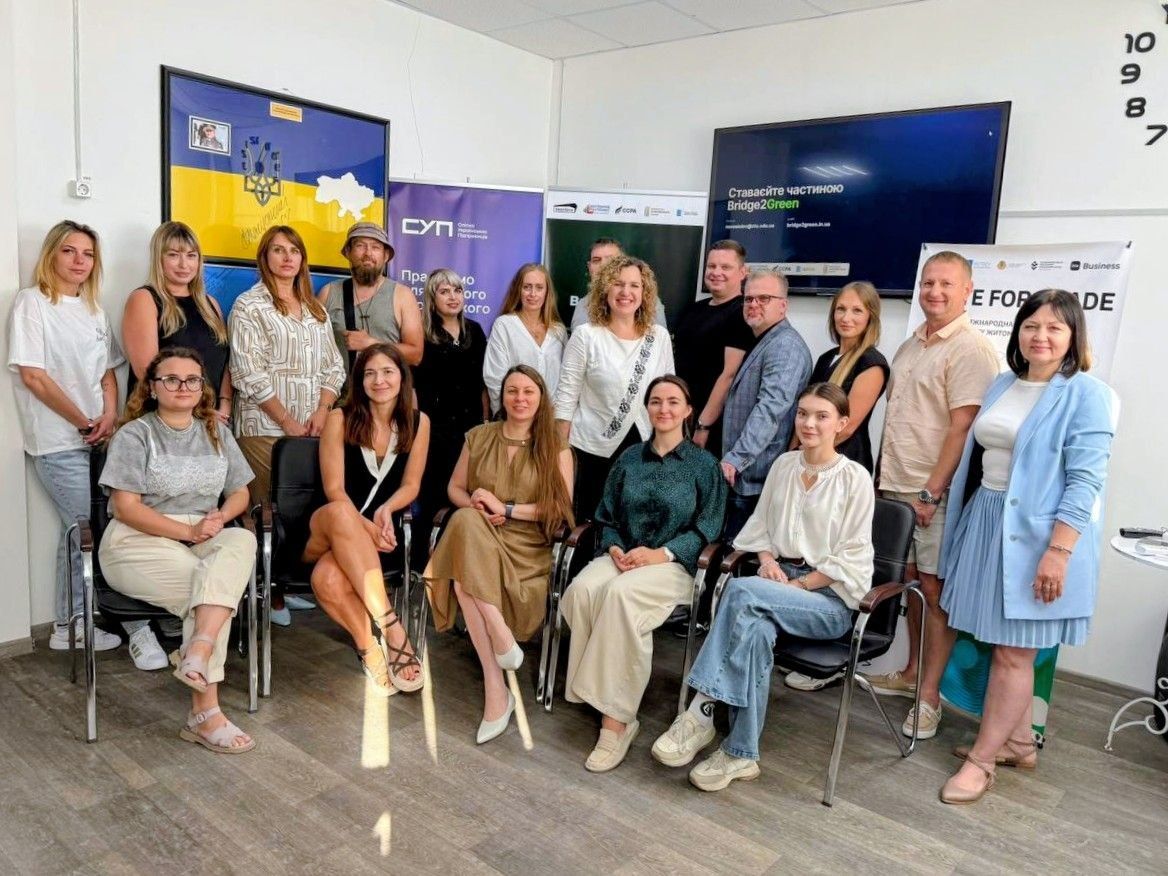
"Meetings like these have been missed in our city"
Even before the program concluded, the Unite for Trade business clubs were held in August in Zhytomyr, Berdychiv, and Korosten. The meetings in the three cities were united by a question: how to shape a local business community that would benefit entrepreneurs in their daily work?
The importance of regular communication and opportunities for cooperation among entrepreneurs themselves, as well as with local governments, educational institutions, and other organizations, were discussed. In each city, the conversations were based on local conditions and challenges.
"An interesting idea for a business meeting. This is exactly what has been missing in our city. We would like to have such meetings more often," noted one participant.
The feedback highlighted the need for regular meetings to exchange experiences and find solutions to issues that are difficult to handle alone. A strong business community is formed over time — through repeated meetings, trust, and joint action. Read more about the business clubs!