
IMPACT-Zhytomyr 3.0
Capacity building program for 11 municipalities of Zhytomyr region in strategic planning and local development. Transforming wartime challenges into investment-ready projects with the support of the Estonian Government and European experts.
Why this programme matters
Today, local self-government bodies in Ukraine are not merely administrative units, but the frontline of the country's resilience, public service delivery and future European integration. The harsh realities of wartime, ongoing infrastructure crises and limited budgets require municipal leaders not only to manage daily crisis response, but also to foster strategic vision, data-driven planning and the capacity to engage effectively with international donors.
The IMPACT-Zhytomyr 3.0 program was created specifically to address these challenges. Drawing on Estonia's experience, the project supports 11 municipalities in Zhytomyr region as they transition from emergency response to systemic development and international investment attraction.
Key program objectives
High-quality investment projects
Train municipalities to develop bankable project profiles that meet EU standards and international donor requirements.
Internal capacity building
Build local expertise and equip municipal teams with tools for independent strategic planning and long-term monitoring.
Bridge for EU cooperation
Build a direct bridge for long-term partnership between Estonian and Zhytomyr municipalities.
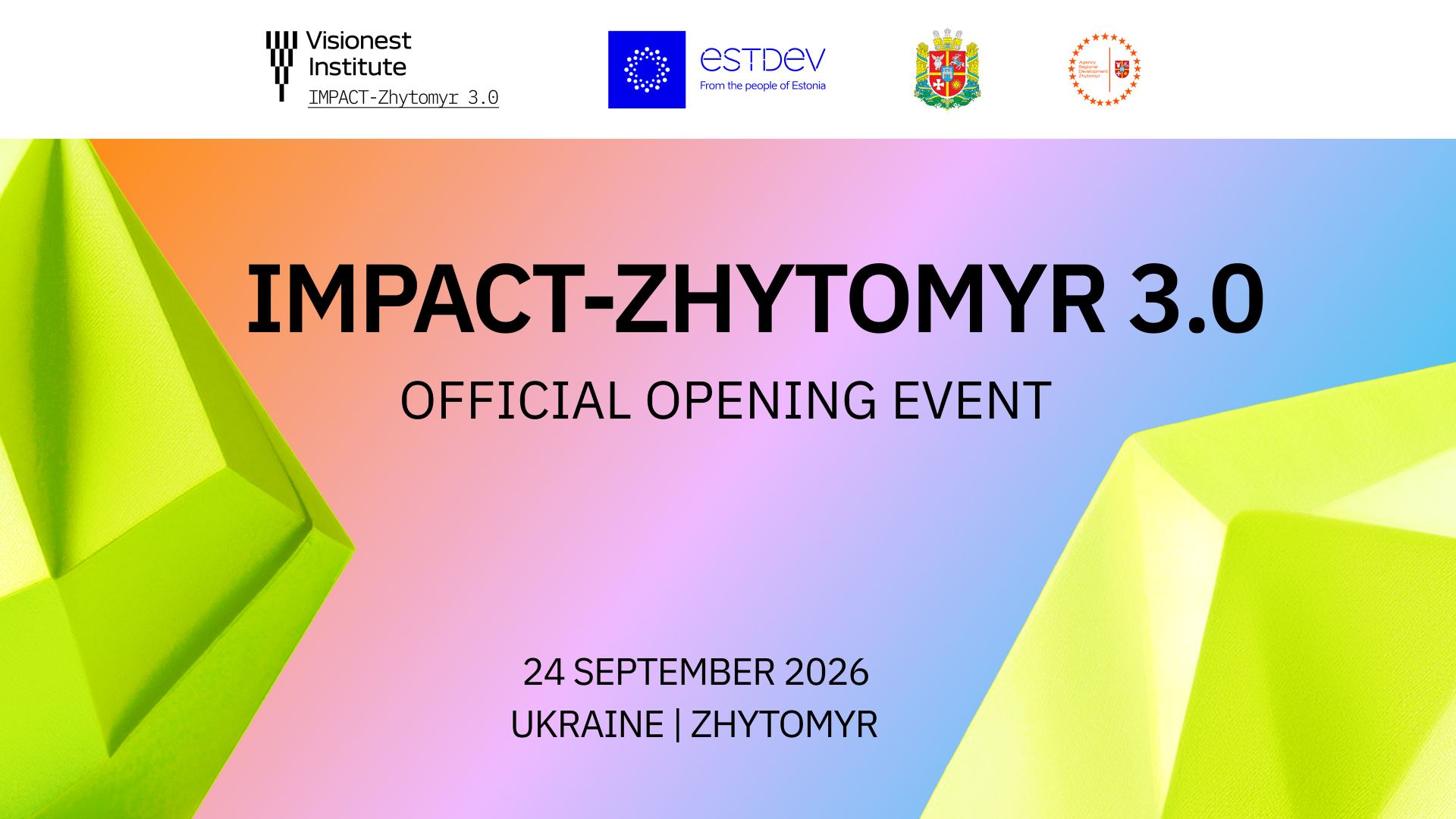
Official program launch & kick-off forum "IMPACT-Zhytomyr 3.0"
- Date
- 24 September 2026
- Location
- Zhytomyr (exact address sent to registered participants for safety reasons)
The event will bring together over 100 participants: heads of the 11 participating municipalities, leadership of the Zhytomyr Regional Military Administration, Estonian diplomats, ESTDEV representatives, Visionest Institute experts, business leaders and civil society organisations.
Registration is open via Google Forms. The full agenda will be published here shortly.
Participating municipalities
Eleven hromadas of Zhytomyr region take part in two tracks, depending on the maturity of their strategic documents.
Strategy development from scratch
4 municipalities receiving comprehensive support in developing new Development Strategies, Strategic Environmental Assessments (SEA) and 4-year Action Plans.
- Berezivka Hromada
- Vyshevychi Hromada
- Semenivka Hromada
- Stryieva Hromada
Implementation & investment projects
7 municipalities updating existing plans, aligning them with local budgets and preparing at least 14 bankable project profiles.
- Popilnia Hromada
- Barashivka Hromada
- Vilshanka Hromada
- Hlybochytska Hromada
- Horshchyky Hromada
- Starosiltsi Hromada
- Chyzhivka Hromada
Program implementation process
- 1Needs assessment & baseline analysis (September – October 2026)Primary data collection and stakeholder mapping across 11 municipalities. Key deliverable: a structured Baseline Report detailing local development needs, strategic planning capacity and priority investment areas.
- 2Practical training program (October 2026 – February 2027)An intensive capacity-building course for municipal officials, specialists and partners: 4 onsite modules, 24 sessions, 72 hours in Zhytomyr. From theory to immediate practical application on real municipal documents.
- 3Strategy & investment project development (February – May 2027)Direct mentorship by Estonian and Ukrainian experts to finalise strategic and project documentation. Key deliverable: 4 new Development Strategies with SEAs for Track 1 and 14 bankable project profiles adhering to EU standards for Track 2.
What municipalities will gain
- Up-to-date strategic documents
- Practical strategic planning tools
- Clear development priorities
- Expert mentorship and guidance
- Bankable project profiles for donor funding
- Estonian and EU best practices
- Enhanced municipal team capacity
- Stronger link between priorities, action plans and budgeting

Training program
The program is structured to equip local officials and specialists with the skills to create high-quality strategic plans, calculate realistic budgets and prepare project proposals aligned with international donor requirements.
Format: 24 practical sessions in 4 residential onsite modules in Zhytomyr, 72 academic hours. Each session runs 1.5–2 hours: a 20-minute mini-lecture, a discussion of local challenges and a practical group exercise on municipal documents.
The training follows a rotational principle: professionals may join the entire program or only the modules relevant to their work. Participants of individual modules receive a certificate of participation; graduates of the full course receive a final certificate from Visionest Institute.
- Analyse municipal data: develop strategies compliant with national legislation and Methodological Recommendations No. 265.
- Engage business and community: apply the Quadruple Helix model to involve local enterprises, academia and civil society.
- Prepare bankable projects: create project concepts following EU Green Transition (DNSH) and Logical Framework (Logframe) standards.
- Align strategies with budgets: draft 4-year action plans matched with available financial resources.
- Navigate donor funding: access funding opportunities from the EU, World Bank, EBRD and ESTDEV.
Module structure
Module 1: Updating strategic goals and stakeholder engagement (Sessions 1–6)+
- 2-day residential module in Zhytomyr
- 6 sessions
Module 2: EU regional development principles and funding sources (Sessions 7–12)+
- 2-day residential module in Zhytomyr
- 6 sessions
Module 3: Transfer of Estonian best practices and budgeting (Sessions 13–18)+
- 2-day residential module in Zhytomyr
- 6 sessions
Module 4: Developing bankable project concepts (Sessions 19–24)+
- 3-day residential module in Zhytomyr
- 6 extended sessions
Frequently asked questions
Who can apply for the training program?+
Applications are open to municipal heads, department directors and specialists (economy, investments, utilities, education, healthcare), council members, as well as official local business and NGO representatives from the 11 participating hromadas.
Can I attend only one specific module, or must I complete the entire course?+
The course operates on a rotational model. Participants can attend modules aligned with their specific professional responsibilities. Single-module attendees receive certificates of participation, while full-course graduates receive a diploma from Visionest Institute.
Is participation strictly onsite, or is there an option to join online?+
Training modules are held in person as 2–3 day residential intensives in Zhytomyr (with accommodation and meals provided) to ensure maximum practical engagement. Select consultations and mentorship sessions may run in a hybrid format.
What is the participation cost?+
Participation, including training materials, accommodation and meals during onsite modules in Zhytomyr, is fully funded by the Estonian Centre for International Development (ESTDEV).
If I am not a local government employee but represent the community, can I participate in the opening event?+
Yes. Representatives of local businesses, NGOs, initiative groups and public institutions are welcome to apply.
How can I submit a development proposal for my hromada?+
Proposals can be submitted during the Needs Assessment phase (September–October 2026) by contacting your local strategic planning working group or via the contact details on this page.
Where can I review the draft strategy for my municipality?+
Draft strategies and related documents will be published on the official websites of participating municipalities for public review and SEA consultations.
Can I provide feedback on investment projects currently under development?+
Yes. Stakeholder consultation sessions are integrated into Module 4 and in project clinics prior to the final project defences.
Partners and organisers
- Implementing organisation
- Visionest Institute (Estonia)
- Donor
- ESTDEV — Estonian Centre for International Development
- Key Ukrainian partners
- Zhytomyr Regional Military Administration · Regional Development Agency of Zhytomyr Region

The program is funded by the Estonian Centre for International Development (ESTDEV). The content of this page is the sole responsibility of Visionest Institute and does not necessarily reflect the views of the donor.
Project Manager

Apply for the training program
Municipal officials, specialists, council members and local business or NGO representatives from the 11 participating hromadas are welcome to apply.
Training applications will open soon — please check back for the registration link.